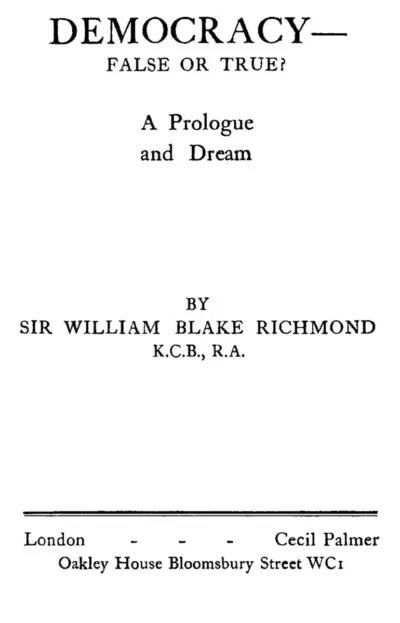
Democracy—False or True?
Read Democracy—False or True? online, or download the free EPUB (works on Kindle too) or PDF.
Edition from Project Gutenberg. Public-domain rules differ by country, so check yours before downloading.
- First published
- 1920
- Pages
- 97Digital editionReference edition
- Reading time
- About 2 hours4 half-hour sittings
- Language
- English
- Reading difficulty
- 6 of 10
A little about the book
Sir William Blake Richmond was a famous painter and Royal Academician. After the First World War, he asks what true democracy should mean. His answer is not about votes but about good work, craftsmanship, country life and spiritual values.
The book is part essay, part parable, ending in a dream vision of a better society. Richmond is old-fashioned and idealistic, and he dedicates it to the honest working classes of England, rich and poor. It’s a curious post-war meditation from an artist rather than a politician.
Is it for you?
You’ll enjoy it if you like
- post-war idealism
- arts and crafts ideas
- essays mixing philosophy and parable
Maybe not if you want practical politics.
Things You May Not Know About Democracy—False or True?
- A painter’s politics. Richmond was a leading portrait painter and designed the mosaics in St Paul’s Cathedral.
- Named after a poet. He was named William Blake in honour of the poet, a friend of his father.
- A dream at the end. The book closes with a visionary ‘dream’ of an ideal society.
- Published in 1920. Cecil Palmer published it in London two years after the war ended.
About this edition
Read the Project Gutenberg source record for edition details. The FreeBookia PDF has 97 pages. The EPUB adjusts to your reading settings.
Get “Democracy—False or True?”
- Free EPUB ebook: one file that works on Kindle, Kobo, Apple Books, Google Play Books and phone reading apps.
- PDF: fixed pages, for printing or reading on a computer.
Reading on Kindle? Send the EPUB to your Kindle with Amazon’s Send to Kindle (app, website or email). Amazon converts it for you.