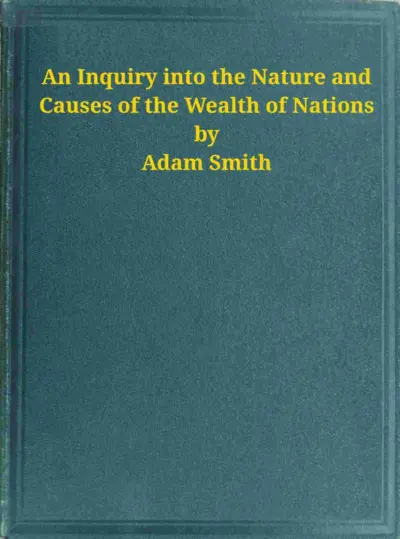
The Wealth of Nations
Read The Wealth of Nations online, or download the free EPUB (works on Kindle too) or PDF.
Edition from Project Gutenberg. Public-domain rules differ by country, so check yours before downloading.
- First published
- 1776
- Pages
- 606Digital editionReference edition
- Reading time
- About 12 hours25 half-hour sittings
- Language
- English
- Reading difficulty
- 8 of 10
A little about the book
Why are some nations rich and others poor? Adam Smith’s answer, published in 1776, became the founding text of modern economics. He shows how dividing work into specialised tasks multiplies what people can produce, using his famous example of a pin factory.
Smith explains markets, prices, wages, money and trade. He argues that people pursuing their own interest can, through competition, end up serving the common good. He also warns against monopolies, merchants’ lobbying and government favours. It’s long, but much more readable and surprising than its reputation.
Is it for you?
You’ll enjoy it if you like
- economics and its origins
- big ideas that shaped the modern world
- clear, reasoned argument
Maybe not if you want a quick read. It's very long.
Where to start
Start with Book I, chapters 1 to 3, on the division of labour. Then dip into the topics that interest you.
Things You May Not Know About The Wealth of Nations
- The invisible hand. The famous phrase appears only once in the whole book.
- A pin factory. Smith’s opening example shows ten workers making 48,000 pins a day by dividing the work.
- Published in 1776. It appeared in the same year as the American Declaration of Independence.
- A moral philosopher. Smith was a professor of moral philosophy, and wrote The Theory of Moral Sentiments first.
- Wary of business. Smith warned that merchants rarely meet without conspiring to raise prices.
About this edition
Read the Project Gutenberg source record for edition details. The FreeBookia PDF has 606 pages. The EPUB adjusts to your reading settings.
Get “The Wealth of Nations”
- Free EPUB ebook: one file that works on Kindle, Kobo, Apple Books, Google Play Books and phone reading apps.
- PDF: fixed pages, for printing or reading on a computer.
Reading on Kindle? Send the EPUB to your Kindle with Amazon’s Send to Kindle (app, website or email). Amazon converts it for you.