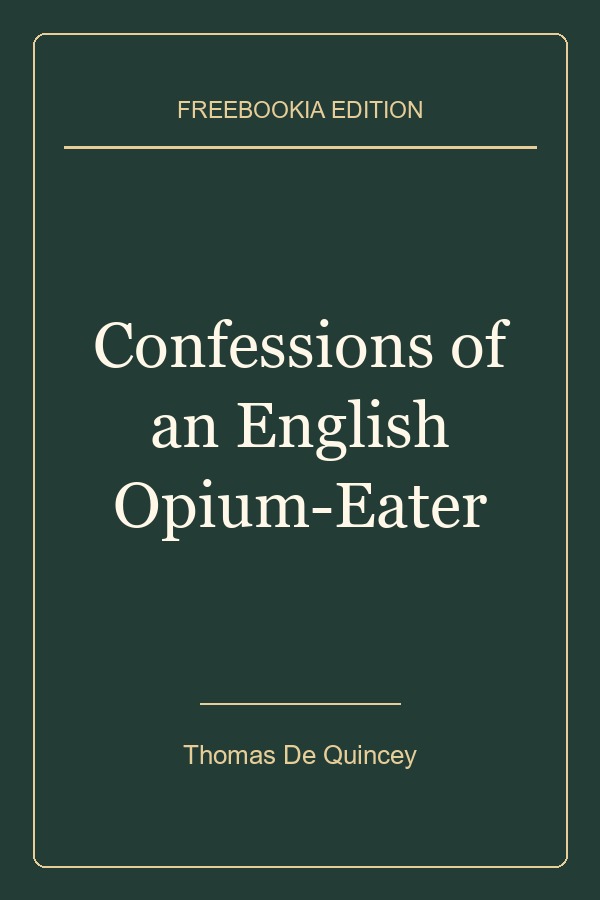
Confessions of an English Opium-Eater
Read Confessions of an English Opium-Eater online, or download the free EPUB (works on Kindle too) or PDF.
Edition from Project Gutenberg. Public-domain rules differ by country, so check yours before downloading.
- First published
- 1821
- Pages
- 105Digital edition
- Reading time
- About 2 hours5 half-hour sittings
- Language
- English
- Reading difficulty
- 8 of 10
A little about the book
Thomas De Quincey recalls the uneasy path that took him from an exceptional schooling to hunger and isolation in London. When he turns to opium, he describes the pleasure and relief it first offered, while also making clear how little those first experiences prepared him for the years that followed.
His account moves between close observation and a more dreamlike register, allowing memories of poverty and friendship to surface alongside the disturbing visions of dependence. It is a strange kind of confession in which the narrator’s vocabulary for an extraordinary experience becomes as important as the experience itself.
Is it for you?
You’ll enjoy it if you like
- memoirs that turn into dream writing
- descriptions of nineteenth-century London
- prose that lingers on memory and sensation
Maybe not if you’re looking for modern medical information about opioids.
Things You May Not Know About Confessions of an English Opium-Eater
- The work began in a magazine. The London Magazine published the confessions anonymously in 1821.
- Pleasure and pain get separate sections. The structure gives each phase of De Quincey’s relationship with opium sustained attention.
- Ann is remembered from his London years. Her kindness matters deeply during the narrator’s early period of hardship.
- The book gives considerable space to dreams. De Quincey uses their shifting scale and imagery to describe the later effects of taking opium.
- The version later grew. De Quincey prepared a substantially expanded revision in the 1850s.
Get “Confessions of an English Opium-Eater”
- Free EPUB ebook: one file that works on Kindle, Kobo, Apple Books, Google Play Books and phone reading apps.
- PDF: fixed pages, for printing or reading on a computer.
Reading on Kindle? Send the EPUB to your Kindle with Amazon’s Send to Kindle (app, website or email). Amazon converts it for you.